
Sample Management for Chemical Companies
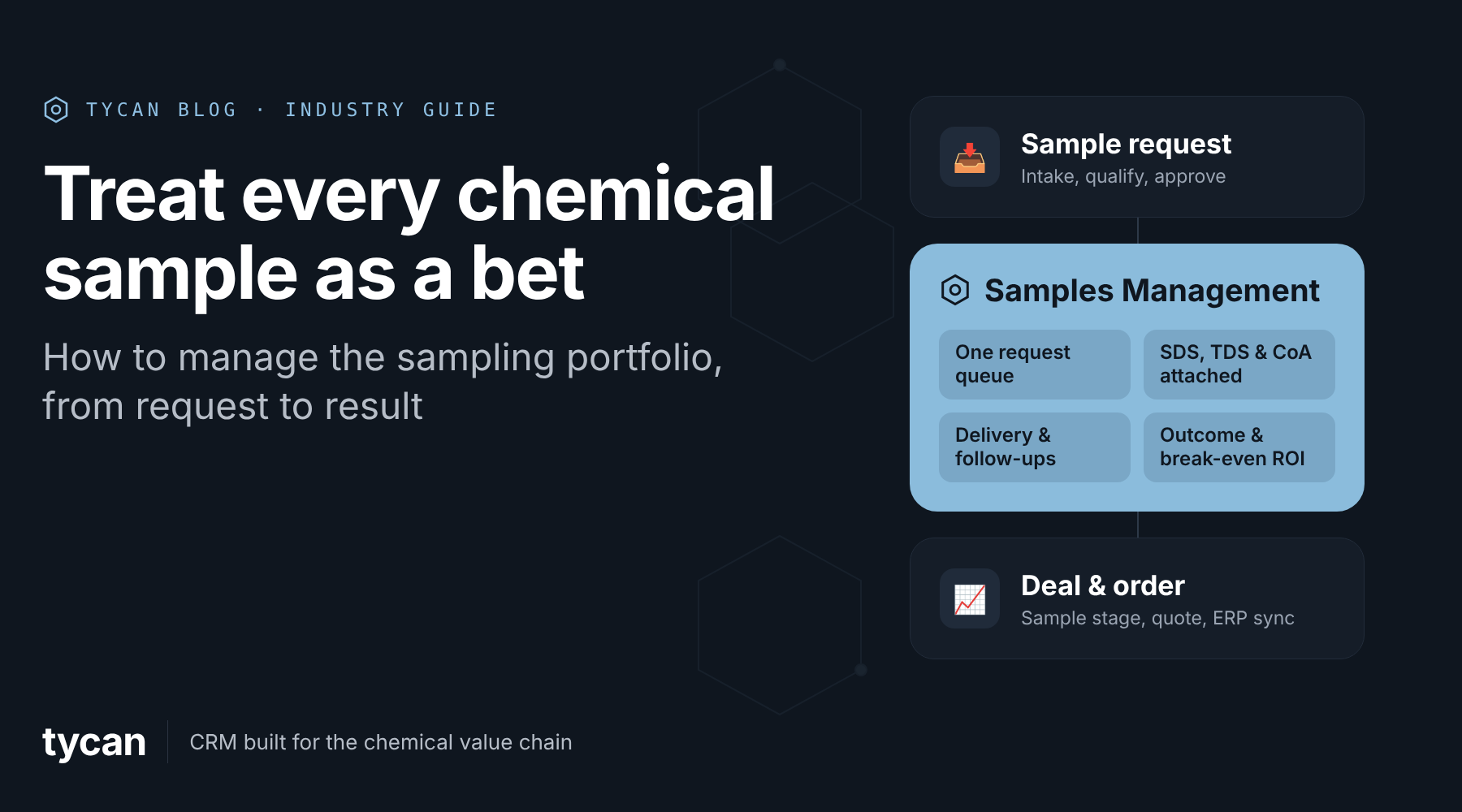
Chemical Sample Management: Treat Every Sample as a Bet and Manage the Portfolio
Gartner surveyed 750 B2B buyers involved in complex purchases and found that they spend just 17 percent of their buying time meeting with potential suppliers.
When three suppliers compete for the same deal, each ends up with roughly 5 percent of that time. The rest of the evaluation happens without you, as the buyer’s team reads, compares, and tests on its own.
In chemicals, testing means material. A sample is one of the few things that stays with the buyer when your rep is not in the room, and it leaves your building with a cost attached before anyone has committed to anything. At Tycan, we treat each sample as a bet and the sampling program as a portfolio.
This guide covers how to manage that portfolio, from the first request to the final result.
What Is Chemical Sample Management?
Chemical sample management is how a company handles each sample from the customer’s first request to a final order or decline. It covers approval, preparation, documents, shipping, delivery tracking, follow-up, and the recorded outcome.
An investor would add that every position needs an owner, a cost, a review date, and a result, and a sample is no different. When a sample is tied to its account, product, contact, and deal, you can see what it cost and what it produced. When it is tied to nothing, nobody can say whether it was a good decision.
Why the Sample Is the Buyer’s Real Meeting
If a rep gets about 5 percent of the buyer’s time, the sample has to carry much of the rest. A buyer cannot judge a coating resin, a surfactant, or a water treatment additive from a brochure alone, so the sample stands in for the supplier during the long stretch when nobody from the supplier is present.
That makes the sample part of your sales presentation. The material should perform, and so should everything around it: how quickly it arrives, whether the right SDS and TDS are in the box, whether the label matches the paperwork, and whether anyone follows up as the test window closes. A buyer who tests three suppliers’ material side by side is also testing three suppliers’ habits. The one that ships late, ships with the wrong document, or never asks for results has shown the buyer something about future orders.
Some bets deserve more capital than others, and some should not be placed at all. The rest of this guide covers how to tell the difference, how to watch positions while they are open, and how to learn from the ones that fail.
Where Bets Are Placed Blind
Most sample losses trace back to five gaps in visibility. The first is intake. Requests come in by email, phone, chat, and trade show conversations, and without one queue, the team funds whichever request is loudest. The second is the handoff between sales and the warehouse. The warehouse packs and ships while the rep waits, and nobody tells the rep the day the box arrived, so the follow-up call is guessed instead of timed.
The third gap is paperwork. Many chemical samples fall under dangerous goods rules, and a wrong classification, declaration, or label can hold a shipment at the border. The sample has cost money and delivered nothing. The fourth gap is follow-up, which usually lives in a rep’s memory and fades once other deals get busy. The fifth is the outcome. Test results end up in an email thread, so leadership sees shipments but never learns which ones paid off.
Many companies assume their ERP covers this. SAP, Oracle, Infor, NetSuite, and Microsoft Dynamics are strong at inventory movements, invoices, and master data, and they can show that 25 kilograms left stock on a given date. They cannot show why the buyer asked, who is running the test, or when someone should call. We built Tycan to add that missing layer on top of the ERP: the request queue, the follow-up schedule, and the link between a sample and its deal. The ERP remains the system of record.
Sizing the Bet: Qualify Before You Ship
No investor backs every idea with the same amount of money. Before a sample ships, three questions sort the request. What is the application? What volume could follow? When does the buyer plan to decide? A buyer who answers all three clearly is a strong position and earns fast, priority handling. A buyer who cannot name an application is a long shot, which may still deserve a small bet but not an expedited courier.
Teams that qualify well tend to write the rules down. Some cap free samples per account and bill additional requests at cost. Others require a stated application before any material leaves the warehouse. Whatever the rule, it works only if the answers are captured at intake and stored with the request. A reason that lives in one rep’s inbox cannot guide the warehouse, the approver, or the person who reviews results six months later.
Watching Open Positions: From Approval to Follow-Up
Once a sample ships, the work changes from deciding to watching. Approval comes first, routed to whoever owns the budget for that account. Preparation follows, and small runs often need special containers and a quality check. The SDS and TDS travel with the material, and a COA joins them when the customer requires one. Dangerous goods classification, labels, and declarations are checked against the destination before dispatch, because cross-border samples leave little room for error.
Delivery is where most programs lose sight of their own work. Status should be visible to sales and the warehouse at the same time, and the confirmed delivery date should start the follow-up clock. From there, a simple rhythm works. Confirm that the sample arrived. Ask about the test a few days later. Raise volumes and timing once results are in. Send a final check if the buyer goes quiet. Adjust the intervals to your products and your customers’ test cycles, but write them down so the rhythm does not depend on memory.
Every position ends in a close. A good result moves into a quote. A poor one gets a recorded reason, such as performance, price, timing, or a competing supplier already approved. Those reasons are the most valuable data a sampling program produces, and they are the first thing teams skip.
What to Look for in Chemical Sample Tracking Software
Chemical sample tracking software has to do more than log shipments. Judge it on four things.
Start with intake and visibility. Every request from every channel should land in one queue, and each sample should link to its account, product, and contact. Sales and the warehouse should read the same live status.
Next comes chemical depth. SDS, TDS, and COA documents should attach to the product without manual effort, and overdue follow-ups should surface on their own. A qualified sample should carry its account and product into the pipeline as an opportunity instead of being re-entered.
Then look at fit with your existing systems. The tool should connect to your ERP without a migration, keep inventory and master data in sync, and report conversion, speed, and cost by product and rep. Role-based access should limit each user to the accounts and regions they handle.
Finally, ask whether chemical fields come standard or need custom development. The answer shapes both your budget and your timeline.
For a broader understanding of how chemical-specific CRM systems handle sample tracking, product records, compliance documents, and sales workflows, read our guide on We Tried a Generic CRM for Chemical Sales. Here Is Where It Broke.
Sample Tracking for Chemical Distributors
Sample tracking for chemical distributors carries a second book of positions. A distributor receives samples from suppliers and sends samples to customers, and the two flows need separate records that still connect to the same product. Broad catalogs create many small requests, so manual tracking fails sooner than it does at a manufacturer with a narrow line.
Stock sits in several warehouses, which means a rep needs live availability by location before promising a sample. Each supplier also issues its own SDS, TDS, and COA, and the distributor has to send the right current version with each shipment. Margin per pound is thin enough that a sample that never converts shows up as a visible cost against it.
How We Handle It at Tycan
Tycan is an AI-powered CRM built for the chemical industry, with 17 modules and more than 15 AI agents. We have live customers in the US, India, and the UAE. Samples Management is the module that carries this work, and it draws on the others.
Picture a hypothetical request from a water treatment formulator who wants a biocide sample before a spring product launch. The rep logs it once, against the account and product, with the quantity, the recipient, and the stated reason. The Lead Scoring Agent ranks the requester on fit and intent, which tells the rep how much effort the request deserves. The Inventory Check Agent confirms live stock pulled from the ERP, and the Compliance module links the current SDS, TDS, and COA to the product. Warehouse and sales work from the same record, and a scheduled follow-up reminds the rep once the sample is dispatched.
If testing goes well, the sample becomes a deal in the Sample stage of our deal board. That stage carries a win probability, so open samples feed the forecast instead of hiding outside it. The Pricing Intelligence Agent suggests pricing by account and product for the follow-on quote, and the Margin Guardrail Agent flags pricing below your threshold before it is confirmed. Distributors can log supplier-side and customer-side samples under separate contact types.
Your ERP remains the system of record. Where your ERP offers an API, Tycan syncs with it in both directions: orders, targets, and activity flow from Tycan to your ERP, while inventory, invoices, and master data flow back into Tycan. Accepted quotes can be pushed straight to your ERP.
Our team handles implementation, and most customers go live in four to six weeks.
To understand how these connected workflows support the wider chemical sales process, explore our guide to Chemical Industry CRM: How Tycan Helps Manufacturers and Distributors.
The Break-Even Test for Sample ROI
A sampling program needs a number to beat. Break-even conversion is the average fully loaded cost per sample divided by the average first-year gross margin of an order. It tells you what share of samples must turn into orders just to cover the spend, and sample ROI is whatever sits above that line.
Take a hypothetical distributor whose fully loaded cost is $220 per sample, counting material, packaging, freight, paperwork, and staff time, and whose typical new order earns $3,000 in first-year gross margin. Break-even is $220 divided by $3,000, or about 7.3 percent. Roughly one sample in fourteen must convert for the program to pay for itself.
The framing changes decisions. At $90 per sample, the same order margin gives a break-even of 3 percent, so a low-cost commodity grade can lose most of its bets and still make money. At $400 per sample, such as a hazardous material shipped overseas, break-even climbs to roughly 13 percent, and qualification has to do real work before anything ships. Set each product line’s break-even beside its actual sample-to-order conversion and the picture becomes practical. Lines that clear the bar by a wide margin deserve more capital, and lines that fall short need a cap or a tighter filter.
Reviewing the Portfolio
A portfolio needs a regular review. Once a quarter, sort closed samples by product, rep, account type, and region, and compare conversion with break-even for each group. Then read the loss reasons. If most losses cite timing, the problem is qualification, because you sampled buyers who were not ready. If they cite performance, product development should see the list. If they cite a competitor already approved, speed and intake are the likely cause. Each pattern points to a different fix, and none of them is visible while outcomes sit in inboxes.
Teams also repeat a handful of mistakes. They count shipments as success when orders and margin are the figures that matter. They leave samples without a single owner even though samples sit between sales, the warehouse, and quality. They skip loss reasons and let paperwork slip, which sends a fast sample out with the wrong document. And they treat every request alike instead of ranking by fit and intent.
A Thirty-Minute Audit
Pick the five largest samples open right now and ask four questions about each. Who owns it? When did it arrive? When is the next follow-up? When will the buyer decide? Every blank answer is a bet nobody is watching.
Fix those first, then decide whether a purpose-built tool would save you the effort.
To see Samples Management and the other 16 modules on your own data, book a demo with us.
Frequently Asked Questions
1. What is chemical sample management?
It is the tracked process of handling each sample from the customer’s first request to a final order or decline. That covers approval, preparation, documents, shipping, delivery, follow-up, and the recorded result. Every sample has an owner, a cost, and an outcome, so none of them disappear into an inbox.
2. Why do chemical companies send samples before an order?
Buyers need to confirm that a product performs in their own application before they commit to volume. A brochure or a certificate cannot show how a resin, additive, or solvent behaves in a specific process, so the sample does that job. It often decides which supplier gets approved.
3. What does chemical sample tracking software do?
It records each sample’s status, owner, documents, and outcome in one place. In Tycan, this is the Samples Management module inside the CRM, so every sample stays linked to the customer and the deal.
4. How is sample tracking for chemical distributors different from a manufacturer’s?
Distributors move samples in two directions, receiving them from suppliers and sending them to customers. They also work with broad catalogs, several warehouses, and supplier-specific SDS, TDS, and COA documents. Tracking has to keep all of that connected to the right product and account, which is harder than managing a single manufacturer’s narrow line.
5. What is break-even conversion?
Break-even conversion is the share of samples that must turn into orders to cover the cost of the whole sampling program. You calculate it by dividing the average fully loaded cost per sample by the average first-year gross margin per order. Anything above that rate is return, and anything below it means the program is losing money.
6. How is break-even conversion different from sample-to-order conversion?
Sample-to-order conversion is the share of shipped samples that actually became orders, so it describes what happened. Break-even conversion is the share you needed, so it describes the target. Comparing the two for each product line shows which lines deserve more samples and which need a cap or tighter qualification.
7. How should we qualify a sample request before shipping?
Ask three questions: what is the application, what volume could follow, and when will the buyer decide? Clear answers justify priority handling, while vague answers justify a smaller bet or a cost-recovery fee. Capture the answers at intake so the approver and the warehouse can see them, not just the rep who took the request.
8. When and how often should we follow up after a sample ships?
Start the clock at confirmed delivery, not at dispatch. A workable rhythm is to confirm arrival first, ask about testing a few days later, discuss volumes once results are in, and send a final check if the buyer goes quiet. Adjust the intervals to your products and your customers’ test cycles, and schedule each step so it does not depend on memory.
9. Will Tycan replace our ERP?
No. Your ERP, whether SAP, Oracle, Infor, NetSuite, or Microsoft Dynamics, stays in place as the system of record. Where it offers an API, data moves both ways, with inventory, invoices, and master data flowing into Tycan and orders, targets, and activity flowing back. We add the sample request queue, the follow-up schedule, and the AI agents on top.
10. How long does it take to get Tycan running?
Most customers go live in four to six weeks. Our own team handles the implementation, including the ERP connection. The exact timeline depends on your ERP, the state of your data, and how many of the 17 modules you start with.
See Tycan on your own data
Book a walkthrough and we'll show the CRM platform, AI agents and AI Order Management working the way a chemical business runs — or see pricing.
Book a demo